
 The house is also a character in the film with its missing ceiling, bug infestations, rattling elevator, red clay coming up through the floorboards, and, of course, its ghosts. I have rambled a bit about the look of the film, but it is the most spellbinding element of the film. The ghosts are so brilliant to look at that I find myself admiring their effects of them instead of being outright terrified every single watching. As gruesome as they are ingeniously imagined I find myself watching them very intently and saying in my head “brilliantly done”.
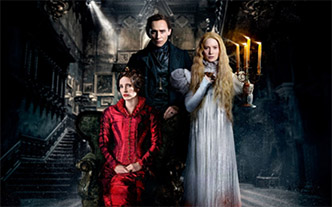
As Crimson Peak's Edith, Mia Wasikowska plays a writer, a Buffalo, New York native, who meets Tom Hiddleston's mysterious, eccentric British aristocrat Sir Thomas Sharpe, and his sister Lucille. Edith is an aspiring novelist. Edith draws comparisons to Jane Austen in Crimson Peak, which she perceives as a slight — she doesn't want to be a romance writer. She prefers horror. (She's in the right movie for that.) Her role model, instead, is Gothic horror writer Mary Shelley, the author best known for Frankenstein. But even when she writes ghost stories instead of romances, these are seen as quaint and endearing rather than terrifying. Unlike Shelley, who was treated as a serious novelist during her lifetime, Edith struggles to be taken seriously. (However, since Shelley's death, the author has been primarily remembered for Frankenstein alone among her written works, and beyond that, as the wife of Percy Bysshe Shelley.)

This crimson clay is, at first glance, a symbol of blood and death so obvious. Yet the use of clay as a visual metaphor highlights a central tension in the film. At the same time, the house itself is a repository of memories and specters. This is not only spiritual, but mechanical, as gramophones replay the secrets of the past, paintings capture the severity of a gaze, and Thomas’s inventions seek to penetrate into the ground to recapture the wealth and influence of his ancestors.
In conclusion, “Crimson Peak” is a brilliant, creepy, and very effective supernatural thriller. It always draws me in. If you ask me, Crimson Peak is obviously Del Toro's love letter to romanticism, gothic horror, and good old-fashioned haunted house stories.

.png)
.png)


No comments:
Post a Comment